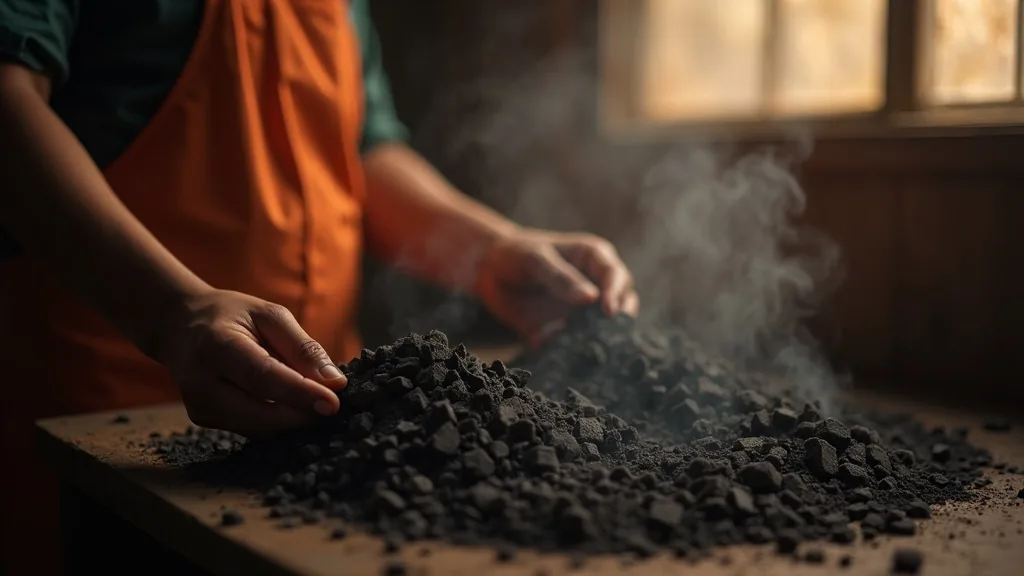
A shisha charcoal manufacturer in Indonesia turns coconut shells into hookah cubes through carbonization, milling, briquetting, oven drying, and screening with metal detection. Premium 25-26 mm cubes from plants in Java and Sulawesi typically test at 1.6-2.5% ash and price at an indicative FOB of USD 1,000-1,600 per metric ton as of 2026 — grade and volume dependent; a written quote confirms.
Indonesia is the world’s number-one producer of coconut-shell charcoal briquettes. Raw shells are drawn heavily from Sulawesi, while briquetting concentrates in Central Java workshops around Magelang, Jepara, Semarang, and the Yogyakarta area, plus plants in Sulawesi itself. Here is what a serious manufacturing partner should show you before you commit a container.
How Is Shisha Charcoal Manufactured in Indonesia?
Every cube starts as a coconut shell. The sequence below is what buyers inspect during factory visits to Java, and what a proper capability deck documents line by line.
| Stage | What happens | QC checkpoint |
|---|---|---|
| 1. Carbonization | Shells burn in low-oxygen kilns into raw charcoal | Char quality, contamination sorting |
| 2. Crushing and milling | Charcoal is ground to a fine, uniform powder | Mesh consistency |
| 3. Mixing and binding | Powder blends with a natural binder, typically tapioca — no chemical accelerants | Binder ratio per batch |
| 4. Briquetting | Hydraulic presses form 22-28 mm cubes | Density, drop-test compression |
| 5. Drying | Oven drying brings moisture to 5% or below | Moisture reading per rack |
| 6. Screening and sorting | Broken or off-spec cubes removed by sieve and hand | Visual and dimensional check |
| 7. Metal detection and packing | Detectors sweep finished cubes before boxing | Foreign-object rejection, batch code |
Two details separate export-grade plants from commodity workshops. First, drying discipline: cubes packed above 5% moisture crack, smoke, and grow mold in transit. Second, batch sampling — cubes pulled from each run for an ash burn-off test and a timed session burn, logged against a traceable batch code.
What Specs Should the Production Line Hold?
Treat the figures below as typical lab-report ranges seen across Indonesian export production, not promises. Per-lot certificates of analysis confirm what actually ships.
| Parameter | Typical range | Notes |
|---|---|---|
| Ash content | 1.6-2.5% | Under 2.5% marks premium; top grades commonly 1.6-2.2% |
| Moisture | 5% or below | Post-drying, held with desiccants in sealed packaging |
| Burn time | 2-2.5+ hours per session | Quality 25 mm cubes documented at 90-120 minutes per piece under controlled conditions |
| Cube sizes | 22, 25, 26, 27, 28 mm | 25 mm and 26 mm are the workhorse hookah formats; custom sizes on request |
| Behavior | Low odor, low smoke, spark-free | Natural binders only, no chemical accelerants |
For context, one 2026 market report puts natural coconut charcoal at 35-55% less ash than quick-light alternatives — the core reason lounges keep specifying Indonesian cubes — and projects roughly 7.1% annual growth for coconut-shell charcoal from 2026 to 2034.
What Monthly Capacity Can a Manufacturer Commit?
Capacity is where marketing claims and production reality diverge fastest, so treat any number that arrives without a scheduling conversation as suspect. A single briquetting line sustains a steady cadence of containers per month once carbonized feedstock, pressing, and drying space are balanced. Drying is usually the bottleneck: racks cannot be rushed without pushing moisture past the 5% ceiling. Larger programs aggregate output across several workshops and plants in Java and Sulawesi under one QC protocol — that is how multi-container monthly volumes get met without cutting drying time.
Seasonality matters as much as line speed. Demand ahead of Ramadan and festival peaks fills slots weeks in advance, and sea freight adds weeks to the UAE and longer to Europe, so order early. As of 2026, buyers are also shifting toward protocol-backed capacity: per-lot COAs covering ash, moisture, fixed carbon, and drop-test compression, plus third-party heavy-metal and PAH testing with traceable batch codes. EU buyers increasingly expect REACH-aware documentation, and GCC markets are tightening scrutiny of additives and emissions.
What Do Manufacturer Prices and MOQs Look Like in 2026?
| Option | Indicative terms, 2026 | Notes |
|---|---|---|
| Premium cube, private label | USD 1,000-1,600 per MT FOB | Indicative, as of 2026, grade and volume dependent; written quote confirms |
| Market context: 100% coconut-shell listings | Around USD 950 per MT FOB | Observed published Indonesian listings as of 2026 — not our offer |
| Market context: coconut-wood mix listings | Around USD 550 per MT FOB | Observed listings, 2026 — a different grade class entirely |
| Minimum order | One 20-foot container | Roughly 18-18.5 MT unpalletized |
| Larger runs | One 40-foot container | About 25.5 MT |
| Packaging | 10 kg master box holding 1 kg inner cartons | Inner-plastic or heat-sealed bag options, desiccants for humidity control |
Payment norms as of 2026 run telegraphic transfer or letter of credit, frequently 30% deposit with 70% against the bill-of-lading copy. The standard document pack covers commercial invoice, packing list, certificate of origin, bill of lading, fumigation certificate where required, and MSDS/SDS on request. Cargo loads through Tanjung Mas in Semarang, Tanjung Priok in Jakarta, Tanjung Perak in Surabaya, or Belawan in Medan, and generally ships as general cargo by sea — air freight faces restrictions, so confirm classification with your forwarder.
How Does a Capability-Deck Request Work?
- Send your brief. WhatsApp or email your cube size, ash target, destination port, and monthly volume. Same-day response during Indonesian business hours.
- Receive the capability deck. Production-stage documentation, typical lab-report ranges, packaging options, and indicative FOB pricing for your volume band.
- Verify with samples. Sample lots dispatch to your market, or hand over in Bali; factory visits to Java and Sulawesi plants are arranged from Bali when volumes justify the trip.
- Confirm in writing. A formal quotation locks grade, cube size, packaging, price, and lead time. Common terms as of 2026: TT or LC, 30% deposit, 70% against bill-of-lading copy.
- Production and shipment. Your slot is scheduled, per-lot QC runs, and cargo loads at port with the full export document pack.
Request the Capability Deck
Tell us your destination port, target cube size, and monthly volume, and the Juara Holding Group BD desk will send the capability deck, typical lab-report ranges, and a written FOB quotation. Shisha Charcoal Supplier is part of Juara Holding Group — an Indonesian group operating from Bali across Indonesia since 2015, with production partners in Java and Sulawesi.
- WhatsApp: +62 811-3941-4563
- Email: [email protected]
- Or use the quote form on the contact page — destination, cargo, and message fields take under a minute.
Frequently Asked Questions
How do I verify a shisha charcoal manufacturer in Indonesia before ordering?
Ask for a capability deck covering each production stage, per-lot lab reports for ash, moisture, and burn time, and traceable batch codes. Then burn-test a sample lot yourself and, when volume justifies it, visit the plant — factory visits to Java and Sulawesi are arranged from Bali. A written quotation should confirm every spec before any deposit moves.
What monthly capacity can Indonesian shisha charcoal manufacturers commit?
Capacity is quoted per line and confirmed in writing, because it depends on kiln throughput, drying space, and existing allocations. A single briquetting line typically sustains a steady container cadence each month, while multi-plant programs across Java and Sulawesi aggregate larger volumes under one QC protocol. Book ahead of Ramadan and festival peaks, when lines fill fastest.
Do Indonesian manufacturers run metal detection and batch testing?
Export-grade plants do. Finished cubes pass metal detectors before boxing, and each production run is batch-sampled for ash, moisture, and a timed burn. As of 2026, buyers increasingly require per-lot certificates of analysis plus third-party heavy-metal and PAH testing tied to traceable batch codes — a requirement moving from marketing language into procurement checklists.
Where is shisha charcoal manufactured in Indonesia?
Briquetting concentrates in Central Java, in workshops around Magelang, Jepara, Semarang, and the Yogyakarta area, with additional plants in Sulawesi, where much of the raw coconut shell originates. Export loading runs mainly through Tanjung Mas in Semarang, Tanjung Priok in Jakarta, and Tanjung Perak in Surabaya. Sourcing, samples, and meetings are handled from Bali.
Can I get samples before committing to a full container?
Yes. Sample lots ship ahead of any container commitment, and samples can be handed over in Bali, with meetings near Ngurah Rai and Denpasar. Some suppliers also accept pallet or trial-lot first orders, and flexible MOQ programs for startup brands are a growing 2027 expectation. Confirm trial terms in the written quotation.