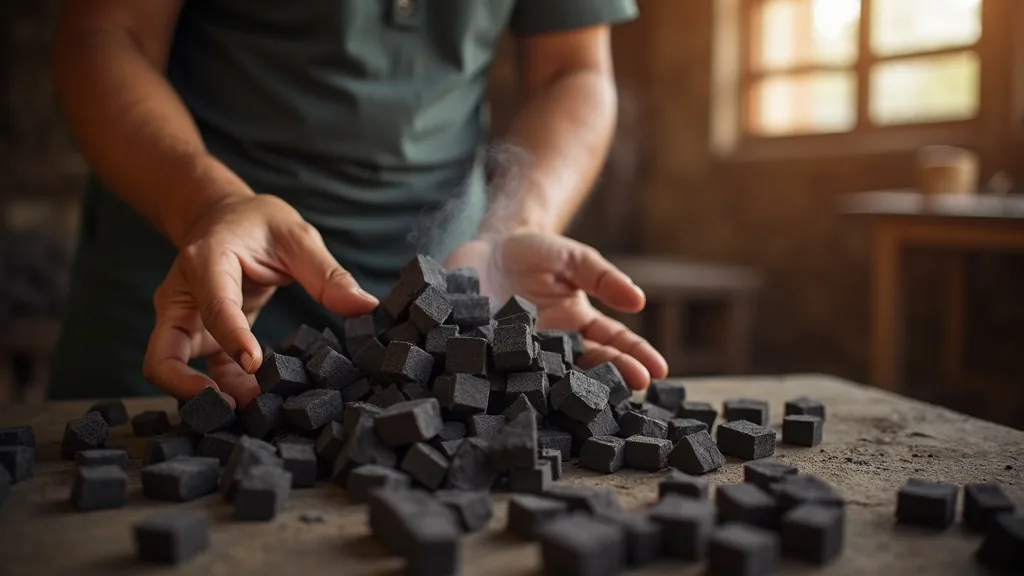
A shisha charcoal factory in Indonesia is almost always a coconut-shell briquetting workshop in Central Java or a plant in Sulawesi, selling premium 25/26 mm cubes at an indicative FOB of USD 1,000–1,600 per metric ton as of 2026 — grade and volume dependent; a written quote confirms — with one 20-foot container as the common minimum order.
Getting from that sentence to a container on the water is where first-time buyers stall. This page maps where production sits, what factory-direct pricing looks like in 2026, how audits and pre-shipment inspection protect your deposit, and how to book samples or a factory visit through our Bali desk.
Where Are Indonesia’s Shisha Charcoal Factories Located?
Indonesia is the world’s number-one producer of coconut-shell charcoal briquettes. Raw shells are drawn heavily from Sulawesi, while briquetting clusters in Central Java workshops around Magelang, Jepara, Semarang, and the Yogyakarta area, plus plants in Sulawesi near the shell supply.
This page names no factories, on purpose: pinning specs and prices to a named plant ages badly and invites copy-paste fraud, so specifications live in the written quote for a specific production lot. The geography, though, is stable — and it drives your freight math. The Central Java belt loads through Tanjung Mas in Semarang, with Tanjung Priok in Jakarta, Tanjung Perak in Surabaya, and Belawan in Medan as alternatives.
Our setup splits cleanly: production stays in Java and Sulawesi; sourcing and business development run from Bali. Factory visits are arranged from Bali, samples handed over in Bali, and first meetings happen near Ngurah Rai airport or in Denpasar.
What Does Factory-Direct Pricing Look Like in 2026?
One canonical number matters: premium coconut-shell shisha cubes at USD 1,000–1,600 per metric ton FOB, indicative as of 2026, grade and volume dependent, confirmed only by a written quote.
| Option | Typical lab-report range | Indicative FOB, 2026 |
|---|---|---|
| Premium hookah cube, 25 or 26 mm | Ash 1.6–2.2%, moisture ≤5%, 2–2.5+ hour sessions | USD 1,000–1,600/MT |
| Premium grade, other sizes (22–28 mm) | Ash under 2.5%, low odor, spark-free | Same band, graded by COA |
| Observed listings, 100% coconut shell | Varies by seller | Around USD 950/MT — market context, not our offer |
| Observed listings, coconut-wood mix | Higher ash, shorter burn | Around USD 550/MT — market context, not our offer |
The last two rows are published Indonesian supplier listings as of 2026, for orientation only. A “premium cube” offer far below the band usually means mixed wood charcoal or high-ash rejects. Treat spec sheets as typical lab-report ranges, not promises: quality 25 mm cubes have been documented at 90–120 minutes per piece, and one 2026 market report puts natural coconut charcoal at 35–55% less ash than quick-light alternatives.
| Order format | Payload | Notes |
|---|---|---|
| 20-foot container | ~18–18.5 MT unpalletized | Common factory MOQ as of 2026 |
| 40-foot container | ~25.5 MT | Best per-ton freight rate |
| Pallet / trial lot | By arrangement | Some factories accept; flexible-MOQ programs are a growing 2027 expectation |
Standard packaging: a 10 kg master box of 1 kg inner cartons, with inner-plastic or heat-sealed bag options and desiccants — the format private-label brands print onto.
How Do You Audit a Factory Before Committing a Container?
A deposit wired against a WhatsApp photo of a warehouse is how buyers lose money. An audit replaces trust with evidence. As of 2026, serious buyers expect per-lot certificates of analysis covering ash, moisture, fixed carbon, and drop-test compression; third-party heavy-metal and PAH testing; and traceable batch codes. EU buyers increasingly want REACH-aware documentation, and GCC markets are tightening scrutiny of additives and emissions.
| Stage | What gets verified | What you receive |
|---|---|---|
| Desk screening | Legal registration, export track record, real capacity | Shortlist memo |
| On-site audit, Java or Sulawesi | Kilns, presses, drying rooms, natural binders (no chemical accelerants), humidity control | Photo and video report |
| Lab sampling | Ash, moisture, fixed carbon, burn behavior | Per-lot COA |
| Pre-shipment inspection | Cube dimensions, drop test, carton print, container loading | Report and loading photos before balance payment |
| Traceability | Batch codes linked to production dates | Audit trail for your own customers |
Demand favors the prepared. One market report projects roughly 7.1% annual growth for coconut-shell charcoal from 2026 to 2034, and factory slots tighten sharply before Ramadan. Audit early, before you need the capacity.
What Happens Between Deposit and Bill of Lading?
Payment norms as of 2026 are telegraphic transfer or letter of credit, most commonly 30% deposit and 70% against the bill-of-lading copy — your balance moves only after cargo is loaded. The standard document pack:
- Commercial invoice and packing list
- Certificate of origin
- Bill of lading
- Fumigation certificate where required
- MSDS/SDS on request
Charcoal generally ships as general cargo by sea; air freight faces restrictions. Sea freight runs a few weeks to the UAE, longer to Europe. Confirm cargo classification with your forwarder before booking — rules differ by port.
How Does a Factory Audit or Sample Request Work?
- Send your brief. Cube size, ash target, monthly volume, destination port, and whether you want private label — through the quote form on the contact page or by WhatsApp.
- Get an indicative quote. Our BD desk replies with matched workshop profiles and an indicative FOB range, typically within two working days.
- Test samples. Collect graded samples in Bali or have them couriered, then burn-test against your current supply.
- Audit the factory. We schedule the Java or Sulawesi visit from Bali — join in person or take the video audit.
- Contract and deposit. Written quote with specs as COA ranges; 30% TT deposit books your production slot.
- Inspection and shipment. Pre-shipment inspection, container loading at the matched port, then 70% against the B/L copy.
> Book a factory audit or request graded samples. The Juara Holding Group BD desk arranges Java and Sulawesi factory visits, Bali sample handovers, and written FOB quotes — one desk, no anonymous middlemen. WhatsApp +62 811-3941-4563, email [email protected], or use the quote form on the contact page. Part of Juara Holding Group — an Indonesian group operating from Bali across Indonesia since 2015.
Frequently Asked Questions
Can I visit a shisha charcoal factory in Indonesia before ordering?
Yes. Factory visits to the Central Java belt — Magelang, Jepara, Semarang, the Yogyakarta area — and to plants in Sulawesi are arranged through our Bali desk. Many buyers start with a meeting near Ngurah Rai or in Denpasar, review samples in Bali, then fly to Java for the audit. If you cannot travel, a photo-and-video audit with live Q&A covers the same checklist.
How do I verify an Indonesian shisha charcoal factory is legitimate?
Ask for business registration, export history, and a per-lot certificate of analysis covering ash, moisture, and fixed carbon — then have samples lab-tested independently. Insist on pre-shipment inspection rights before the balance payment. Treat offers far below the indicative 2026 band of USD 1,000–1,600 per metric ton for premium cubes as a warning sign, not a bargain.
What is the minimum order from a shisha charcoal factory in Indonesia?
As of 2026, most factories set the minimum at one 20-foot container, roughly 18–18.5 metric tons unpalletized; a 40-foot container carries about 25.5 metric tons and lowers per-ton freight. Some workshops accept pallet or trial-lot orders, and flexible MOQ programs for startup hookah brands are a growing expectation heading into 2027.
Do Indonesian shisha charcoal factories produce private-label brands?
Yes — private label is standard. The usual format is your branded 1 kg inner carton packed ten to a 10 kg master box, with inner-plastic or heat-sealed bag options and desiccants for humidity control. Cube sizes run 22 mm to 28 mm with custom sizes on request; custom packaging generally requires container-scale volume.
How long does shipping take from an Indonesian factory to my port?
Sea freight from Java’s ports runs a few weeks to the UAE and longer to Europe, on top of the production slot itself. Charcoal moves as general cargo by sea — air freight faces restrictions — so build lead time into your calendar and order well ahead of Ramadan and festival peak seasons, when factory slots tighten.