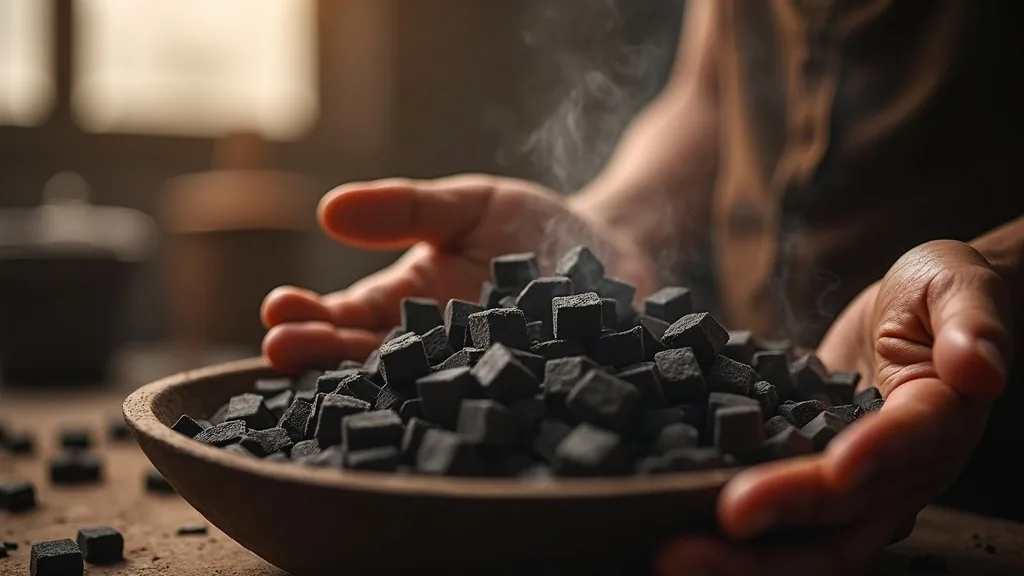
An Indonesian shisha charcoal buyers guide comes down to five decisions: pick a cube size (25 mm or 26 mm for most hookah menus), demand a per-lot COA with ash under 2.5%, choose factory-direct or trader deliberately, budget USD 1,000-1,600 per metric ton FOB for premium cubes (indicative, as of 2026), and plan around one 20-foot container.
Below: supply chain, cube formats, lab reports, MOQ math, payment norms, ports — every figure date-stamped; only a written quote from a shisha charcoal supplier in Indonesia confirms it.
How does the Indonesian coconut-shell supply chain work?
Indonesia is the world’s number-one producer of coconut-shell charcoal briquettes, and the chain runs in two stages. Raw shells are drawn heavily from Sulawesi; briquetting — carbonising, milling, mixing with natural binders, pressing, oven-drying — concentrates in Central Java workshops around Magelang, Jepara, Semarang, and the Yogyakarta area, plus plants in Sulawesi itself.
That two-region structure matters. Shell prices and pressing capacity move independently, so a good coconut shell shisha charcoal supplier manages both ends. When either side tightens — wet-season shell collection, pre-Ramadan surges — lead times stretch at the Indonesian coconut charcoal briquettes factory level before any hookah charcoal supplier in Indonesia tells you. Ask where the shells come from and where the pressing happens.
Which cube size should you order — and how many pieces per kg?
Indonesian workshops press 22, 25, 26, 27, and 28 mm cubes, with custom sizes on request. The 25 mm and 26 mm formats are the workhorse hookah sizes, and any serious shisha charcoal cubes supplier quotes both.
| Cube size | Approx. pieces per 1 kg pack | Where it fits |
|---|---|---|
| 22x22x22 mm | ~96-108 | Smaller bowls, budget retail |
| 25x25x25 mm | ~72 | Global workhorse; lounge standard |
| 26x26x26 mm | ~64 | Premium lounge menus |
| 27x27x27 mm | ~56-60 | Larger bowls, heat-hungry setups |
| 28x28x28 mm | ~48-54 | Long-session premium lines |
Counts shift with density and moisture, so confirm pieces-per-kg on the packing specification — lounges cost sessions per piece, not per kilo.
How do you read a COA before wiring a deposit?
A certificate of analysis separates export-grade product from a nice-looking photo. Treat every figure as a typical lab-report range for that lot — not a promise.
| COA line | Typical Indonesian lab-report range | What to check |
|---|---|---|
| Ash content | 1.6-2.5%; under 2.5% marks premium, top grades commonly 1.6-2.2% | Which lab, which lot, how recent |
| Moisture | At or below 5% | Higher moisture = cracking, weak ignition |
| Fixed carbon | Reported per lot | Compare across lots from the same supplier |
| Burn time | 2-2.5+ hours per session; quality 25 mm cubes documented at 90-120 minutes per piece (controlled conditions) | Ask the test method, then burn a sample |
| Drop test / compression | Reported on request | Predicts breakage in transit |
A low ash shisha charcoal supplier should re-issue a COA per shipment — the same for long burn shisha charcoal cubes supplier and low odor shisha charcoal supplier claims; natural binders light spark-free with low smoke. One 2026 market report puts natural coconut charcoal at 35-55% less ash than quick-light alternatives; 2026 buying trends run toward per-lot COAs, heavy-metal and PAH testing, and traceable batch codes.
Should a first-time importer buy from a factory or a trader?
Factory-direct means pricing closer to production cost, custom cube sizes, and direct QC access at a shisha charcoal manufacturer in Indonesia — but usually full-container MOQ, slower correspondence, and no help with export paperwork. A trader offers smaller mixed lots and faster replies, but stacked margins and specs that can drift between orders.
Most first-timers land in the middle: a supplier desk that contracts vetted workshops — the practical way to reach a shisha charcoal factory in Indonesia without auditing one yourself — and enforces per-lot COAs. A shisha charcoal factory near Bali is really a BD and sampling base; production stays in Java and Sulawesi. An OEM shisha charcoal manufacturer builds your spec from scratch; a white label shisha charcoal supplier puts your artwork on a proven recipe — faster and cheaper for a first brand.
What do MOQ, prices, and payment terms look like in 2026?
| Item | Norm as of 2026 |
|---|---|
| Premium cube FOB band | USD 1,000-1,600/MT — indicative, as of 2026, grade and volume dependent; written quote confirms |
| Market context | Published Indonesian listings: ~USD 950/MT FOB for 100% coconut-shell, ~USD 550/MT coconut-wood mix (observed listings, not an offer) |
| MOQ | Commonly one 20-foot container, roughly 18-18.5 MT unpalletized; a 40-foot carries about 25.5 MT |
| Trial orders | Some suppliers accept pallet or trial lots; flexible MOQ for startup brands is a growing 2027 expectation |
| Payment | Telegraphic transfer or letter of credit; frequently 30% deposit, 70% against bill-of-lading copy |
| Packaging | 10 kg master box holding 1 kg inner cartons; heat-sealed bag options with desiccants |
Cross-check any shisha charcoal wholesale price against this band, ask for a current coconut shell shisha charcoal price list by grade and volume, and get private label shisha charcoal quoted as its own line item.
How does ordering work, step by step?
- Send a spec-complete RFQ — cube size, target ash, moisture, packaging, volume, destination port.
- Review the per-lot COA and request samples — deliverable in Bali (meetings near Ngurah Rai/Denpasar) via a Bali shisha charcoal supplier for export.
- Approve the sample and confirm the written quote — the pro-forma invoice fixes grade, volume, packaging, and Incoterm (FOB baseline).
- Pay the 30% deposit by TT or open an LC; production is scheduled on payment.
- Production and QC — drop test, moisture check, fresh COA; factory visits to Java and Sulawesi are arranged from Bali via a coconut charcoal briquettes supplier in Bali.
- Loading and bill of lading — the remaining 70% is commonly paid against the BL copy.
- Documents and arrival — track transit and clear customs with your forwarder.
Which ports and documents move your container?
Main loading ports: Tanjung Mas (Semarang, Central Java), closest to the Java workshop belt, plus Tanjung Priok (Jakarta), Tanjung Perak (Surabaya), and Belawan (Medan). Charcoal generally ships as general cargo by sea; air freight faces restrictions. Sea freight runs weeks to the UAE and longer to Europe, so an Indonesian coconut charcoal supplier for the UAE program or a shisha charcoal supplier for Europe line should order ahead of Ramadan and festival peaks.
The 2026 document pack: commercial invoice, packing list, certificate of origin, bill of lading, fumigation certificate where required, and MSDS/SDS on request. Confirm tariff classification and destination rules with your forwarder — EU buyers are moving toward REACH-aware documentation, and GCC scrutiny of additives and emissions is tightening as of 2026.
Where do you get a written quote?
The BD desk at Juara Holding Group — an Indonesian group operating from Bali across Indonesia since 2015 — handles spec sheets, per-lot COAs, samples in Bali, and written FOB quotes. Message +62 811-3941-4563 on WhatsApp, email [[email protected]](mailto:[email protected]), or use the quote form on this site. No guaranteed specs, no locked prices — a written quote against your RFQ is the only number that counts.
Frequently Asked Questions
How do I import coconut shell charcoal cubes from Bali?
Sampling and meetings happen in Bali; cargo ships from Java ports such as Tanjung Mas or Tanjung Priok. Confirm spec and per-lot COA, approve a sample, sign the pro-forma invoice, pay a 30% deposit, then 70% against the bill-of-lading copy. Book a forwarder early and confirm destination import rules.
Which supplier is better, factory direct or trading company?
Factory direct gives closer-to-cost pricing, custom sizes, and private-label control, but expects full-container MOQ and replies slowly. Traders take smaller mixed lots yet stack margins, and specs can drift between orders. Many first-time buyers use a supplier desk that contracts vetted Java and Sulawesi workshops and enforces a fresh COA on every lot.
How many pieces per kilogram are in 25mm cubes?
A 1 kg inner pack of 25x25x25 mm cubes commonly holds around 72 pieces; 26 mm packs run around 64. Exact counts move with density and moisture, so confirm pieces-per-kg on the packing specification and pro-forma invoice. Lounges price sessions per piece, so the count matters as much as the per-ton rate.
How do I compare ash percentage between charcoal suppliers?
Compare per-lot COAs, never brochure claims. Typical Indonesian lab reports show 1.6-2.5% ash; under 2.5% marks premium, and top grades commonly test 1.6-2.2%. Ask which laboratory tested the specific lot, insist on a fresh certificate per shipment, then burn a sample — fine, pale ash should support the printed number.
How do I prepare product specs for a charcoal RFQ?
State cube size (say 26x26x26 mm), target ash under 2.5%, moisture at or below 5%, packaging (1 kg inners, 10 kg master box), volume (one 20-foot container, roughly 18-18.5 MT), destination port, and required documents. A precise RFQ earns a precise quote; a vague one gets a padded band.