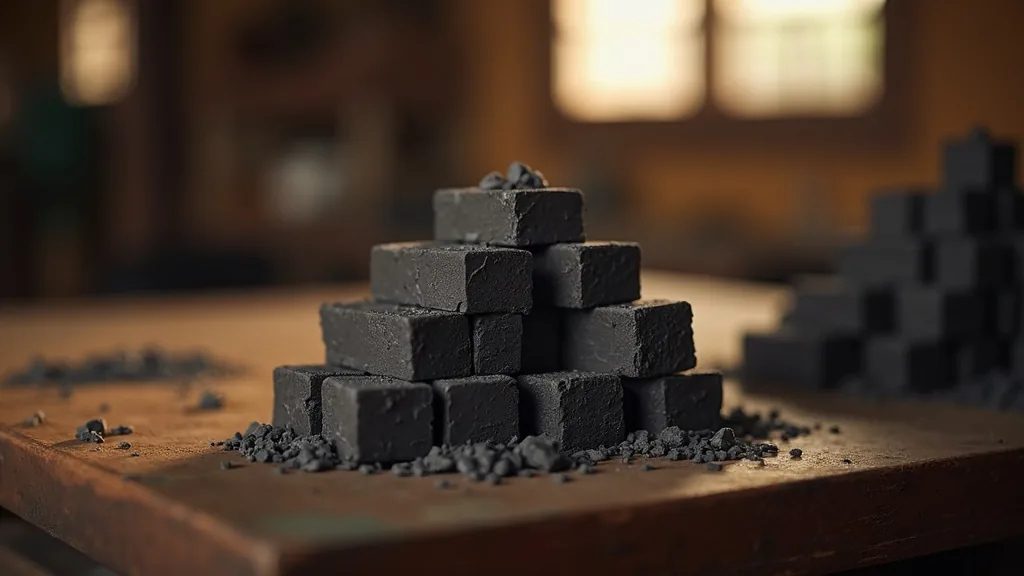
An Indonesian coconut charcoal briquettes factory typically presses cube, hexagonal, finger, and flat formats from coconut-shell char, with premium shisha cubes at USD 1,000-1,600 per metric ton FOB as of 2026 — indicative, grade and volume dependent; a written quote confirms. Most factory-direct orders start at one 20-foot container, roughly 18-18.5 metric tons unpalletized.
Indonesia is the world’s number-one producer of coconut-shell charcoal briquettes. Raw shells come heavily from Sulawesi, while briquetting concentrates in Central Java workshops around Magelang, Jepara, Semarang, and the Yogyakarta area, plus plants in Sulawesi. Below: the shape portfolio, 2026 pricing, container loading norms, and the capacity checklist to run before wiring a deposit.
What Shapes Does an Indonesian Briquettes Factory Produce?
Shisha cubes are the volume driver for export factories, but the same press lines and feedstock support four other families. Standard cube sizes in the Indonesian market run 22x22x22 through 28x28x28 mm, with 25 mm and 26 mm as the workhorse hookah formats and custom sizes on request.
| Shape | Common formats | Primary market | Notes |
|---|---|---|---|
| Shisha cube | 22, 25, 26, 27, 28 mm | Hookah lounges, retail brands | 25-26 mm dominate; custom sizes by mold |
| Hexagonal | Pressed logs, cut to length | BBQ and grilling | Center channel aids airflow and ignition |
| Finger / stick | Extruded sticks, cut to length | Restaurant grilling, yakitori-style use | Dense pack, steady heat plateau |
| Flat / tablet | Slab and tablet pressings | Burners, specialty retail | Slower rollout; confirm mold availability |
| Custom | Per drawing or sample | Private-label programs | Tooling adds lead time; ask before quoting |
Every format is pressed with natural binders rather than chemical accelerants, which is what produces the low-odor, low-smoke, spark-free behavior lounges pay for. Typical lab-report ranges as of 2026 — read these as typical, not promises: ash 1.6-2.5%, with under 2.5% marking premium and top grades commonly 1.6-2.2%; moisture at or below 5%; burn time 2 to 2.5+ hours per session under controlled conditions, with quality 25 mm cubes documented at 90-120 minutes per piece.
How Much Do Factory-Direct Briquettes Cost in 2026?
| Product | Indicative FOB, as of 2026 | Status |
|---|---|---|
| Premium coconut-shell shisha cube | USD 1,000-1,600 / MT | Our working band — indicative, grade and volume dependent; written quote confirms |
| 100% coconut-shell charcoal | Around USD 950 / MT | Observed published Indonesian supplier listings, 2026 — market context, not our offer |
| Coconut-wood mix | Around USD 550 / MT | Observed listings, 2026 — budget tier; verify ash and odor before committing a brand to it |
Two pricing rules protect buyers. Treat any figure quoted without a grade, cube size, and volume as marketing — only a written quote against a defined spec confirms price. And compare like with like: a coconut-wood mix at USD 550 per ton is not the same product as a 100% shell cube, and the difference shows up on the ash tray.
Payment norms as of 2026 are telegraphic transfer or letter of credit, frequently structured as a 30% deposit with 70% against the bill-of-lading copy. The standard document pack covers commercial invoice, packing list, certificate of origin, bill of lading, fumigation certificate where required, and MSDS/SDS on request.
How Many Tons Fit in a 20ft or 40ft Container?
- A 20-foot container loads roughly 18-18.5 metric tons unpalletized — the most common minimum order as of 2026.
- A 40-foot container carries about 25.5 metric tons unpalletized.
- Palletizing reduces payload; weigh the handling benefit against the lost tonnage per box.
- Some factories accept pallet or trial-lot orders, and flexible MOQ programs for startup brands are a growing 2027 expectation.
- Standard export packaging is a 10 kg master box holding 1 kg inner cartons, with inner-plastic or heat-sealed bag options and desiccants for humidity control.
Main loading ports are Tanjung Mas in Semarang, Tanjung Priok in Jakarta, Tanjung Perak in Surabaya, and Belawan in Medan. Sea freight runs weeks to the UAE and longer to Europe, so order ahead of Ramadan and festival peaks. Charcoal generally ships as general cargo by sea; air freight faces restrictions — confirm cargo requirements with your forwarder.
How Do You Verify a Factory’s Real Capacity?
Factory claims are cheap; evidence is not. Before committing a container, run this checklist — a serious workshop in Java or Sulawesi passes all eight without friction.
- Per-lot COA covering ash, moisture, fixed carbon, and drop-test compression — the direction buyers are pushing as of 2026.
- Batch-coded samples matching the quoted grade, not a hand-picked showcase box.
- Export track record: a prior bill of lading and certificate of origin, even redacted.
- Dated video walk-through of press lines, drying ovens, and warehouse stock — recorded for you, not a brochure clip.
- Monthly output stated in containers, checked against your order size and their existing commitments.
- Full document-pack capability, including fumigation certificate where required and MSDS/SDS on request.
- Third-party heavy-metal and PAH testing with traceable batch codes — becoming a procurement requirement on the 2027 trajectory, especially for EU and GCC buyers.
- A physical visit option: factory visits to Java and Sulawesi arranged from Bali, samples deliverable in Bali, meetings near Ngurah Rai or Denpasar.
How Does Ordering Work?
- Send your spec. Shape, cube size, target ash, volume, and destination port — by WhatsApp, email, or the quote form.
- Receive an indicative quote. Within one working day: FOB band against your spec, typical lab-report ranges, and packaging options.
- Sample and verify. Batch-coded samples ship to you or hand over in Bali; test burn time, odor, and ash yourself.
- Confirm in writing. Proforma invoice fixes grade, price, packaging, and schedule; 30% deposit by TT or LC opens production.
- Production with proof. Per-lot COA, loading photos, and container seal numbers before departure.
- Balance and documents. 70% against the bill-of-lading copy; full document pack follows to your broker.
Where Do You Get a Factory-Direct Quote?
Send your shape, spec, and destination to the Juara Holding Group BD desk and get an indicative FOB quote with typical lab-report ranges within one working day. We are the sourcing and BD side — production stays with vetted workshops and plants in Java and Sulawesi.
- WhatsApp: +62 811-3941-4563
- Email: [[email protected]](mailto:[email protected])
Part of Juara Holding Group — an Indonesian group operating from Bali across Indonesia since 2015.
Frequently Asked Questions
How do I verify an Indonesian coconut charcoal briquettes factory before ordering?
Ask for four things: a recent per-lot COA covering ash, moisture, and fixed carbon; batch-coded samples of the exact grade quoted; export evidence such as a prior bill of lading; and a dated video walk-through of the press lines and ovens. As of 2026, credible factories in Java and Sulawesi supply all four without hesitation — refusal on any one is a signal.
What briquette shapes can Indonesian factories produce besides shisha cubes?
The same coconut-shell feedstock supports hexagonal logs and finger sticks for BBQ and restaurant grilling, flat or tablet pressings for burners, and fully custom shapes from a drawing or sample. Cubes remain the export workhorse at 22-28 mm, but a factory with spare mold capacity can usually add a second shape to the same container to test a market.
How many tons of coconut briquettes fit in a shipping container?
As of 2026, a 20-foot container loads roughly 18-18.5 metric tons unpalletized, and a 40-foot container carries about 25.5 metric tons. Palletizing cuts payload in exchange for easier handling. The 20-foot load is the most common minimum order, though some suppliers accept pallet or trial-lot volumes for brands still proving demand.
Can I visit the factory in Indonesia before placing an order?
Yes. Factory visits to workshops and plants in Java and Sulawesi are arranged from Bali, where the BD desk is based. Samples can be delivered in Bali and meetings held near Ngurah Rai airport or Denpasar, so a buyer can combine verification with a normal Bali trip before committing a 30% deposit on a container.
Do Indonesian briquette factories handle private-label packaging?
Yes. The standard export format — a 10 kg master box holding 1 kg inner cartons — prints to your brand, with inner-plastic or heat-sealed bag options and desiccants for humidity control. Minimum order is commonly one 20-foot container as of 2026, though flexible MOQ programs for startup brands are a growing 2027 expectation.