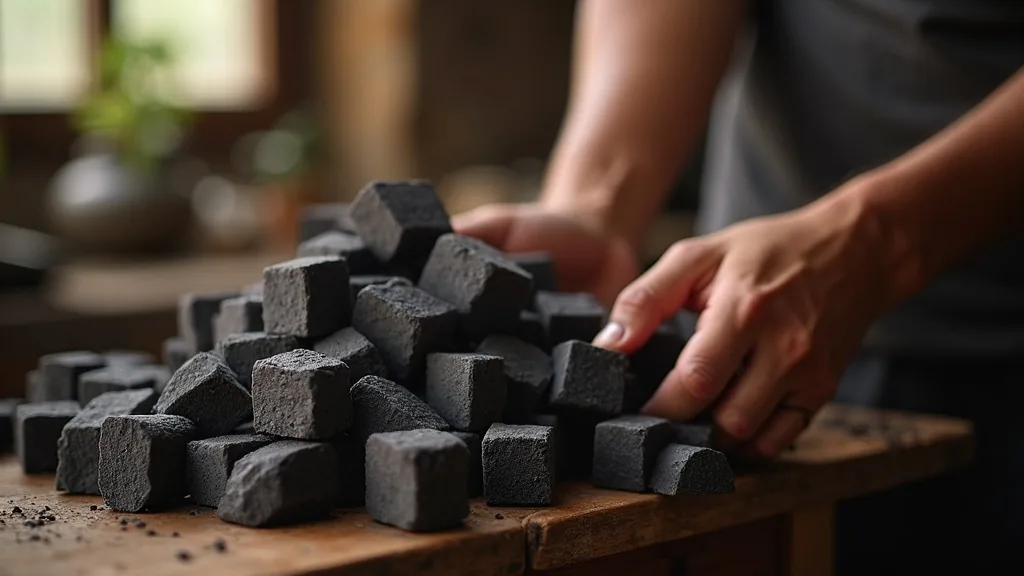
A low ash shisha charcoal wholesale supplier should hold finished cubes under 2.5% ash — the threshold that separates premium coconut-shell charcoal from commodity grades. Cubes we source from Indonesian workshops typically test at 1.6–2.2% ash on lab reports, with FOB pricing of USD 1,000–1,600 per metric ton — indicative, as of 2026, grade and volume dependent; a written quote confirms.
What Counts as Low Ash in Wholesale Shisha Charcoal?
Ash is the mineral residue left behind once the fixed carbon in a cube has burned off. The more residue a coal produces, the faster it smothers its own heat, the more often lounge staff have to clean bowls, and the more grey dust drifts across tables. Serious buyers write an ash ceiling into the purchase contract instead of accepting “low ash” as a marketing line.
Indonesia produces more coconut-shell charcoal briquettes than any other country. Raw shells come heavily from Sulawesi, while briquetting is concentrated in Central Java workshops around Magelang, Jepara, Semarang, and the Yogyakarta area, plus plants in Sulawesi. Well-run lines press fully carbonized shell with natural binders and no chemical accelerants, which is exactly what keeps ash, odor, and sparking down. One 2026 market report puts natural coconut charcoal at 35–55% less ash than quick-light alternatives — a gap lounge managers notice within one shift.
| Grade band | Typical ash (lab-report range) | What it means in the lounge |
|---|---|---|
| Top export grade | 1.6–2.2% | Stable heat through 2–2.5+ hour sessions; minimal tray dust |
| Premium threshold | Under 2.5% | The contract ceiling wholesale buyers should specify as of 2026 |
| Commodity or mixed material | Above 2.5% | Frequent coal changes, visible dust, uneven heat |
These figures are typical lab-report ranges, not guarantees — which is precisely why the per-lot certificate of analysis discussed below matters more than any brochure. Moisture belongs in the same clause: at or below 5%, cubes light predictably and resist crumbling in transit.
White Ash or Black Ash: Which Signals a Clean Cube?
A fully carbonized coconut-shell cube burns down to a fine white-to-light-grey ash that holds its shape on the tray. Dark grey or black residue usually points to incomplete carbonization, wood mixed into the shell feedstock, or excess binder — all of which push the ash percentage up and drag heat quality down.
Treat ash color as a first screen at the sample stage, not as a spec. A cube can ash white and still miss your contractual ceiling. The lab report, not the tray, settles the contract — burn the sample for behavior, then read the numbers for the decision.
How Do Per-Lot COAs Protect Wholesale Buyers?
A certificate of analysis issued per production lot is the difference between a verified spec and a recycled PDF. As of 2026, wholesale buyers are shifting hard toward protocol-backed documentation: per-lot COAs covering ash, moisture, fixed carbon, and drop-test compression, plus traceable batch codes that tie every master box back to a production run. Third-party heavy-metal and PAH testing is moving from nice-to-have to procurement criterion, particularly for EU buyers who expect REACH-aware documentation and GCC markets tightening scrutiny of additives and emissions.
Our sourcing practice follows that trajectory. Every quoted lot from our partner workshops in Java and Sulawesi ships with a COA stating ash, moisture, and fixed carbon, tied to a batch code. Lounges facing indoor-air-quality questions get a lab-tested low-odor product file they can actually show — not a verbal assurance from a trading desk.
What Do Low Ash Cubes Cost at Wholesale?
| Item | Detail (as of 2026) |
|---|---|
| Premium low-ash cube, FOB Indonesia | USD 1,000–1,600 per MT — indicative, grade and volume dependent; written quote confirms |
| Minimum order | Commonly one 20-ft container, roughly 18–18.5 MT unpalletized; pallet and trial-lot programs on request |
| 40-ft container load | About 25.5 MT |
| Cube sizes | 25 mm and 26 mm workhorse hookah formats; 22, 27, and 28 mm plus custom sizes on request |
| Packaging | 10 kg master box holding 1 kg inner cartons; inner-plastic or heat-sealed bags with desiccants |
| Payment norms | Telegraphic transfer or letter of credit; frequently 30% deposit, 70% against bill-of-lading copy |
| Loading ports | Tanjung Mas (Semarang), Tanjung Priok (Jakarta), Tanjung Perak (Surabaya), Belawan (Medan) |
For market context only: published Indonesian supplier listings as of 2026 showed 100% coconut-shell charcoal offered around USD 950/MT FOB and coconut-wood mix around USD 550/MT. Those are observed listings, not our offer — and a usefully cheap “coconut” cube at the bottom of that range is often a wood blend that will ash dark and fail a 2.5% ceiling.
Plan freight realistically: sea shipments run weeks to the UAE and longer to Europe, so order ahead of Ramadan and festival peak seasons. Standard document pack: commercial invoice, packing list, certificate of origin, bill of lading, fumigation certificate where required, and MSDS/SDS on request. Confirm classification details with your forwarder — charcoal generally moves as sea general cargo, and air freight faces restrictions.
How Does a COA-Plus-Sample Order Work?
- Send your spec. WhatsApp or email the BD desk your destination port, cube size, ash ceiling, and monthly volume.
- Receive matched lab ranges. We reply with typical COA figures from workshops in Java and Sulawesi that fit your spec, plus the COA format you would receive per lot.
- Burn-test a sample. Sample packs are deliverable in Bali — meetings near Ngurah Rai or Denpasar work well — or couriered to you with the lot’s COA.
- Confirm in writing. A written quote fixes price, cube size, packaging, and the per-lot COA commitment. Indicative bands become contract numbers here.
- Place the deposit. Commonly 30% by telegraphic transfer or letter of credit; production begins under a traceable batch code.
- Review pre-shipment documents. Invoice, packing list, certificate of origin, fumigation certificate where required; the 70% balance is typically paid against the bill-of-lading copy.
- Track to port. Loading from Tanjung Mas, Tanjung Priok, Tanjung Perak, or Belawan, with shipping documents forwarded as the vessel departs.
Request a COA and Sample Pack
Send one message with your destination, cube size, and monthly volume, and the BD desk replies with current lab-report ranges, a sample plan, and a written indicative quote. Factory visits to Java and Sulawesi can be arranged from Bali. Part of Juara Holding Group — an Indonesian group operating from Bali across Indonesia since 2015.
WhatsApp: +62 811-3941-4563 · Email: [[email protected]](mailto:[email protected])
Frequently Asked Questions
What ash percentage should I write into a wholesale contract?
Specify a ceiling of 2.5% ash for premium positioning, then ask what the supplier’s recent lots actually tested. Top Indonesian export grades commonly show 1.6–2.2% on lab reports as of 2026. Treat published ranges as typical performance, not promises, and make the per-lot COA — never the brochure — the contractual reference document.
Does lower ash mean a shorter burn time?
No. Ash measures mineral residue, not energy content. Quality 25 mm coconut-shell cubes in the 1.6–2.2% typical ash band are documented at 90–120 minutes per piece under controlled conditions, supporting sessions of 2 to 2.5+ hours. Dense, fully carbonized cubes deliver both low residue and long heat; under-carbonized material fails on both counts.
How can I verify a low-ash claim before committing to a full container?
Order a sample pack together with the COA from that same production lot, then burn-test it yourself: check that the ash comes out white to light grey and holds shape. For production orders, confirm the supplier issues per-lot COAs with traceable batch codes. Third-party heavy-metal and PAH testing can be arranged for regulated markets.
Can a startup brand order less than a 20-foot container?
Sometimes, yes. The common minimum as of 2026 is one 20-ft container of roughly 18–18.5 metric tons unpalletized, but some Indonesian suppliers accept pallet or trial-lot orders, and flexible MOQ programs for startup brands are a growing 2027 expectation. Tell the BD desk your realistic monthly volume and we will match a workshop accordingly.