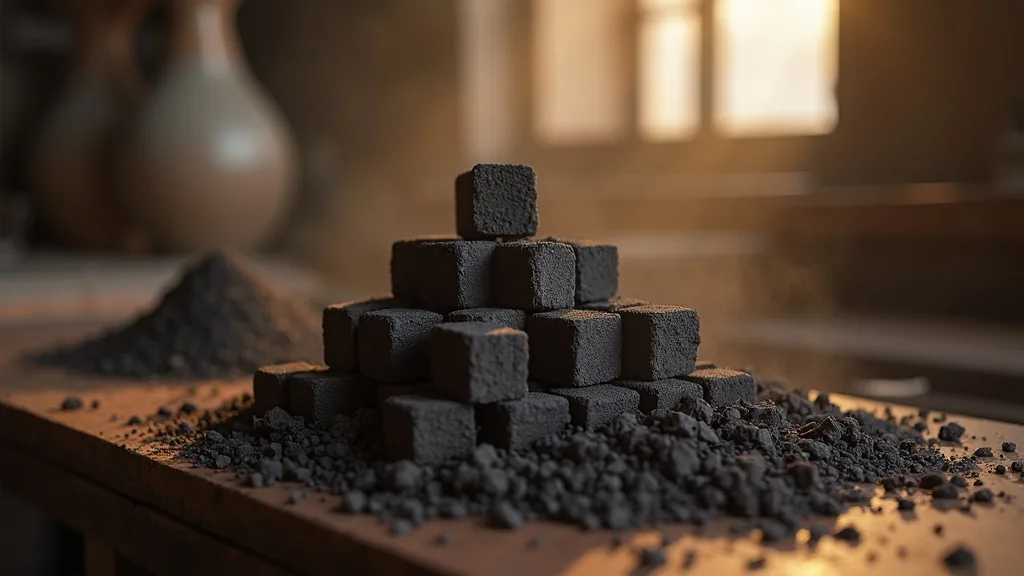
A coconut shell shisha charcoal supplier worth your container ships cubes pressed from 100% coconut shell — no wood filler — with ash between 1.6% and 2.5%, moisture at or below 5%, and burn times past two hours. The cubes we export are pressed in Central Java and Sulawesi workshops from Sulawesi raw shell, at an indicative FOB of USD 1,000–1,600 per metric ton as of 2026, grade and volume dependent; a written quote confirms.
That phrase — 100% shell — is the most abused claim in this trade. Plenty of “coconut” briquettes leaving Indonesian ports carry coconut wood or mixed biomass blended into the shell char. The mix presses cleanly, looks identical in the master box, and costs the producer far less. Your lounge customers find out twenty minutes into a session, when the ash piles up pale and an off odor creeps into the smoke.
Why does 100% coconut shell beat a shell-wood mix?
Coconut shell carbonizes into a dense, slow-burning char. Coconut wood and softwood fillers char lighter and faster, so a blended cube runs hot early, dies sooner, and leaves more ash. Indonesia is the world’s number-one producer of coconut-shell charcoal briquettes, which is exactly why the market attracts blenders: shell supply is finite, and stretching it with wood widens margin.
| Attribute | 100% coconut shell | Shell-wood mix |
|---|---|---|
| Typical ash (lab reports) | 1.6–2.5%; top grades commonly 1.6–2.2% | Higher; residue paler and bulkier |
| Odor in session | Low, near-neutral | Woody, smoky notes carry into flavor |
| Burn time (typical, controlled) | 2–2.5+ hours; quality 25 mm cubes documented at 90–120 minutes per piece | Shorter, with less even heat |
| Observed FOB listings, 2026 | Around USD 950/MT | Around USD 550/MT |
| Best fit | Hookah lounges, premium retail brands | Budget grilling, price-led markets |
Those two listing prices deserve a pause. Published Indonesian supplier listings as of 2026 showed 100% coconut-shell charcoal offered around USD 950 per metric ton FOB, while coconut-wood mixes sat near USD 550 — observed market listings, not our offer. That gap of roughly USD 400 is the wood. A quote for “premium pure shell” priced like a mix is telling you what is actually in the cube.
One 2026 market report put natural coconut charcoal at 35–55% less ash than quick-light alternatives, and projected roughly 7.1% annual growth for coconut-shell charcoal from 2026 through 2034. Demand is moving toward pure shell faster than shell supply grows.
Where do the shells actually come from?
Raw shell for Indonesian shisha cubes is drawn heavily from Sulawesi, where coconut processing leaves large, steady volumes of mature shell. The carbonized shell then moves to briquetting workshops concentrated in Central Java — around Magelang, Jepara, Semarang, and the Yogyakarta area — with additional plants in Sulawesi pressing closer to the raw material.
The binder matters as much as the shell. Proper shisha cubes use a natural starch binder with no chemical accelerants, which is what produces the low-odor, low-smoke, spark-free behavior lounges expect over a charcoal burner. If a supplier cannot state its binder in writing, treat the cube as untested.
Our sourcing and BD base sits in Bali: factory visits to Java and Sulawesi are arranged from Bali, samples can be handed over on the island, and meetings near Ngurah Rai or Denpasar are routine. Production stays in Java and Sulawesi.
What should a lab report show before you commit?
Ask for typical chemical-analysis ranges per lot, not brochure adjectives. For premium 100% shell cubes, typical lab-report ranges as of 2026 look like this — read them as documented ranges, not guarantees:
- Ash content: 1.6–2.5%, with under 2.5% marking premium grade and top lots commonly 1.6–2.2%
- Moisture: at or below 5%
- Burn time: 2 to 2.5+ hours per session under controlled conditions
- Cube sizes: 22, 25, 26, 27, and 28 mm, with 25 mm and 26 mm the workhorse hookah formats; custom sizes on request
Buyer expectations are tightening. As of 2026, serious importers increasingly require per-lot COAs covering ash, moisture, fixed carbon, and drop-test compression, plus third-party heavy-metal and PAH testing and traceable batch codes — an expectation hardening into standard procurement practice through 2027, particularly among EU and GCC buyers.
How much does pure shell cost, and in what quantities?
| Order option | Approximate quantity | Indicative FOB, as of 2026 | Notes |
|---|---|---|---|
| Sample pack | 1–2 kg assorted cubes | Courier cost; quoted on request | Hand-over in Bali possible |
| Trial pallet | Fractional lot | Per written offer | A growing option for startup brands |
| 20-ft container (common MOQ) | ~18–18.5 MT unpalletized | USD 1,000–1,600/MT | Standard first order |
| 40-ft container | ~25.5 MT | USD 1,000–1,600/MT | Best freight economics per ton |
All figures are indicative, as of 2026, grade and volume dependent; a written quote confirms.
Standard packing is a 10 kg master box holding 1 kg inner cartons, with inner-plastic or heat-sealed bag options and desiccants for humidity control. Loading runs from Tanjung Mas (Semarang), Tanjung Priok (Jakarta), Tanjung Perak (Surabaya), or Belawan (Medan). Payment norms as of 2026 are telegraphic transfer or letter of credit, commonly a 30% deposit with 70% against the bill-of-lading copy. The document pack covers commercial invoice, packing list, certificate of origin, bill of lading, fumigation certificate where required, and MSDS on request. Charcoal ships as general sea cargo — air freight faces restrictions — and transit runs weeks to the UAE and longer to Europe, so order ahead of Ramadan and festival peaks.
How does a sample-pack request work?
- Send your spec. Use the form on the contact page or WhatsApp: destination country, cube size, monthly volume, and whether you need private-label packaging.
- Receive a written indication. The BD desk replies with an indicative offer against the 2026 band, typical lab ranges for the lot family, and packaging options.
- Get the sample. We dispatch 1–2 kg by courier, or hand it over in Bali if you are on the island.
- Test it your way. Burn-test under your own lounge conditions and, ideally, send a portion to an independent lab for ash and moisture.
- Book the trial container. Confirm grade and cube size, sign against a written quote, pay the 30% deposit, and receive documents against the bill-of-lading copy.
> Request a sample pack. Message the Juara Holding Group BD desk on WhatsApp at +62 811-3941-4563 or email [[email protected]](mailto:[email protected]) with your destination port and target monthly volume. Part of Juara Holding Group — an Indonesian group operating from Bali across Indonesia since 2015.
Frequently Asked Questions
How can I verify a coconut shell shisha charcoal supplier really ships 100% shell?
Burn one cube fully and weigh the ash: pure shell leaves a compact 1.6–2.5% residue, while mixes leave paler, bulkier ash. Demand a per-lot COA stating ash and moisture, plus batch codes. Then sanity-check price — published 2026 listings put pure shell around USD 950/MT FOB, so a “pure” quote near mix pricing is a red flag.
Why is 100% coconut-shell charcoal so much more expensive than mixed cubes?
The raw material and the yield. Shell is a finite by-product that carbonizes slowly and densely; wood filler is cheap and abundant. As of 2026, observed Indonesian listings showed roughly USD 950/MT for pure shell against USD 550/MT for coconut-wood mixes. You are paying for lower ash, longer burn, and a flavor-neutral session — the things lounges resell.
Can I get a sample pack before committing to a full container?
Yes — that is the intended first step. Send your destination, cube size, and monthly volume via the form or WhatsApp +62 811-3941-4563, and the BD desk arranges a 1–2 kg courier shipment or a hand-over in Bali. Test the cubes under your own lounge conditions before any container commitment; the sample stage carries no purchase obligation.
Does it matter that the raw shells come from Sulawesi?
It matters for consistency. Sulawesi’s coconut processing produces large, steady volumes of mature shell, which chars evenly — the base for stable ash and burn numbers lot after lot. Briquetting then happens in Central Java workshops and Sulawesi plants. A supplier who can name its shell region and show batch codes is usually running a real, traceable chain.